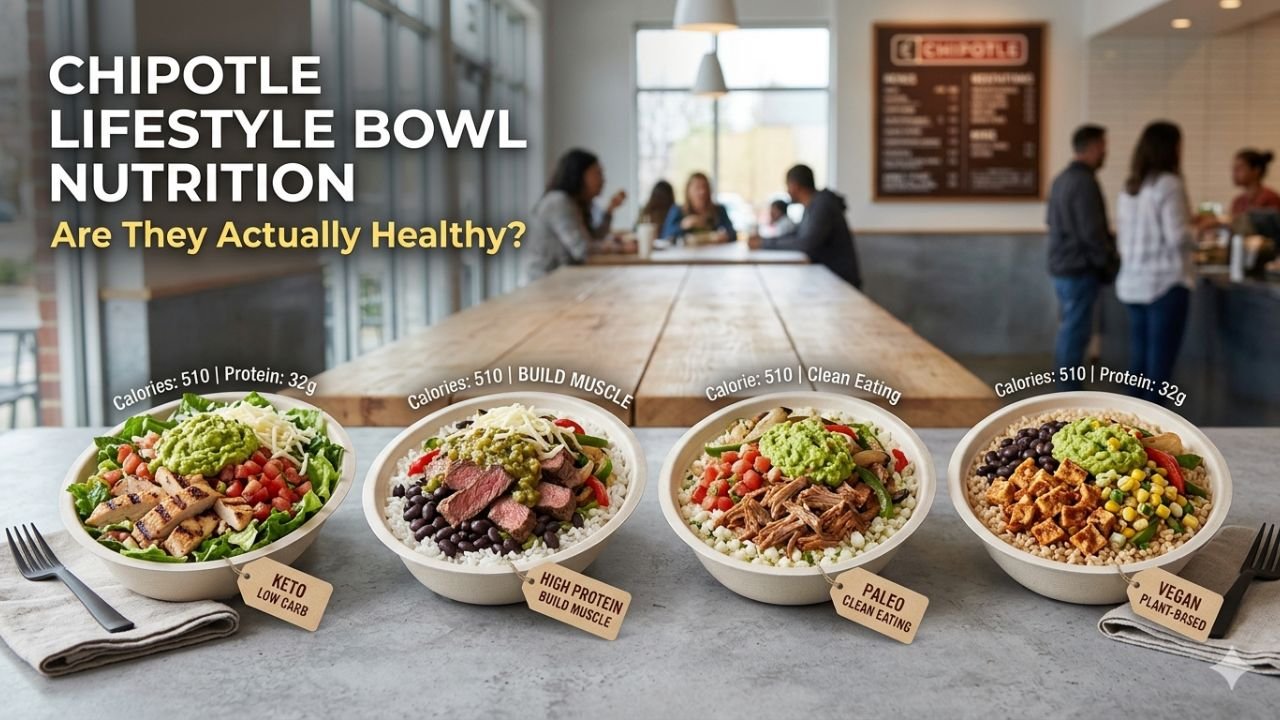
You’re standing at the Chipotle counter, maybe a little tired, a little hungry, and honestly just trying to make a decent food choice. Then you spot it in the Lifestyle Bowls section. A pre-built menu of options with names like “Wholesome Bowl” and “Keto Bowl” that basically scream, “Hey, we did the healthy thinking for you!”
Sounds perfect, right?
But here’s the thing: a lot of people grab one of these bowls, feel great about their “healthy” choice, and have no idea what they actually just ate. Some of these bowls are genuinely solid options. Others? They’re hiding some serious numbers behind a wholesome name.
So let’s break it all down. We’re going to dig into Chipotle Lifestyle Bowl nutrition, look at what’s actually inside each option, and figure out whether these pre-built bowls are truly healthy or just cleverly marketed.
Spoiler: the truth is somewhere in the middle, and it depends a lot on your personal health goals.
What Are Chipotle Lifestyle Bowls, Exactly?
Chipotle introduced Lifestyle Bowls as a way to make ordering easier for people following specific diets. Instead of building your bowl from scratch (which, let’s be honest, can get complicated when you’re trying to hit a calorie target), these bowls come pre-configured.
As of recent years, the Lifestyle Bowl lineup has included options like:
- Keto Bowl
- Wholesome Bowl
- Paleo Bowl
- Whole30 Bowl
- High Protein Bowl
- Veggie Full Bowl
- Plant-Based Whole30 Bowl
Each one is designed to align with a particular eating philosophy. The idea is smart. Chipotle is essentially saying, “Tell us your diet, and we’ll build your meal.” But the nutritional reality of each bowl is what we really need to talk about.
Breaking Down the Chipotle Lifestyle Bowl Nutrition, One Bowl at a Time
The Keto Bowl
The Keto Bowl is built for people following a very low-carb, high-fat, moderate protein diet.
Here’s roughly what’s inside: a salad base (no rice, no beans), supergreens or romaine lettuce, carnitas or steak, cheese, guacamole, and sour cream.
Nutritional breakdown (approximate):
- Calories: 665–710
- Fat: 49–55g
- Carbs: 11–13g (net carbs even lower)
- Protein: 38–42g
For a keto dieter, this is a dream. The fat content is high, the carbs are minimal, and the protein is solid. But if you’re not doing keto and you just ordered this thinking it’s “light,” you might be surprised that nearly 50+ grams of fat in one bowl is a lot for the average eater.
Bottom line: Great for keto. Not automatically “healthy” for everyone.
The Paleo Bowl
The Paleo Bowl removes grains, dairy, and legumes- basically anything a prehistoric human theoretically wouldn’t have eaten.
Typical ingredients: romaine lettuce base, chicken or steak, fresh tomato salsa, guacamole.
Nutritional breakdown (approximate):
- Calories: 500–570
- Fat: 26–30g
- Carbs: 21–24g
- Protein: 34–38g
This one is actually one of the more balanced options in the lineup. You’re getting clean protein, healthy fats from the guac, and fiber from the veggies. The calorie count is moderate, and nothing here is going to raise too many red flags.
If you’re not specifically doing Paleo but you want a lighter, clean-eating option, this bowl works pretty well.
The Whole30 Bowl
Similar to the Paleo Bowl but a bit stricter: no dairy, no legumes, no grains, no added sugars.
Typical ingredients: romaine lettuce, chicken, fresh tomato salsa, guacamole, and fajita veggies.
Nutritional breakdown (approximate):
- Calories: 490–540
- Fat: 24–28g
- Carbs: 25–30g
- Protein: 33–37g
This is one of the lightest options in the lineup and genuinely healthy for most people. The carb count is a little higher than Keto or Paleo (due to fajita veggies), but these are all whole-food carbs, not refined or processed.
Real-life tip: If you’re not doing Whole30 but want a satisfying, lower-calorie bowl, this is one of the best picks on the board.
The High Protein Bowl
Okay, this one is popular and for good reason.
The High Protein Bowl typically includes: white rice, black beans, double chicken (or chicken + steak), fresh tomato salsa, and cheese.
Nutritional breakdown (approximate):
- Calories: 830–900
- Fat: 26–30g
- Carbs: 72–78g
- Protein: 65–75g
Here’s where it gets interesting. The protein count is impressive, easily hitting 65–75 grams, which is great for anyone lifting weights, recovering from workouts, or just trying to stay full for hours.
But the calorie count is also notably high. And the carbs from the double rice and beans add up fast.
Is it healthy? For an active person with higher calorie needs, absolutely. For someone with a sedentary lifestyle trying to lose weight, it might be a bit much in one sitting.
The Veggie Full Bowl and Plant-Based Whole30 Bowl
These are Chipotle’s plant-focused options.
The Veggie Full Bowl includes: rice, beans, fajita veggies, fresh tomato salsa, guacamole, and sour cream.
Nutritional breakdown (approximate):
- Calories: 770–820
- Fat: 29–34g
- Carbs: 97–105g
- Protein: 19–24g
Here’s the surprise most people don’t expect: the Veggie Bowl is actually one of the higher-carb, higher-calorie options. The combination of rice, beans, and guac adds up. The protein is lower than in the meat-based bowls, which is worth knowing if you’re eating plant-based food for fitness reasons.
The Plant-Based Whole30 Bowl strips away the rice, beans, and dairy and replaces them with sofritas (tofu-based protein), guac, and veggies. It’s significantly lower in calories and carbs but also lower in protein.
Are Chipotle Lifestyle Bowls Actually Healthy?
Here’s the honest answer: it depends on what “healthy” means to you.
There’s no one-size-fits-all definition of a healthy meal. What works brilliantly for someone doing keto might be completely wrong for someone managing blood sugar. What’s perfect for a 200-pound athlete recovering from a workout would be excessive for someone trying to lose weight.
That said, here’s what we can say with confidence:
The Lifestyle Bowls have real advantages:
- They’re made with whole, recognizable ingredients
- No ultra-processed junk hidden in the base recipes
- Chipotle is transparent about its nutrition data (available on its website and app)
- They remove the guesswork for people following specific diets
- Customization is always on the table. You can ask for modifications.
Where they fall short:
- Some bowls are very high in sodium (the Keto Bowl with sour cream, guac, and cheese can push past 1,000mg)
- The calorie range varies wildly (from around 490 to 900+ calories)
- The “healthy” label implied by the name can mislead people into thinking all options are low-calorie
- Portion sizes at Chipotle tend to run large, which is great for value, but not always great for calorie control.
Practical Tips for Ordering Smarter at Chipotle
Whether you’re ordering a Lifestyle Bowl or building your own, here are some genuinely useful tips:
- Start with the right base: Supergreens or romaine cuts carbs significantly compared to white rice. If you’re managing calories, this one swap alone saves 200+ calories.
- Don’t fear the guac, but be aware of it. Guacamole is nutritious (healthy fats, fiber, potassium), but a Chipotle serving of guac adds around 230 calories and 22g of fat. Worth it? Usually yes. But worth knowing.
- Protein matters more than you think. Higher protein means you’ll stay fuller longer. If you’re eating one big meal and need it to last, the double-protein options (even if higher calorie) may serve you better than a lighter bowl that leaves you snacking an hour later.
- Watch the sodium: cheese, sour cream, and certain salsas are the sodium culprits. If you’re watching salt intake, the fresh tomato salsa is the lowest-sodium topping option.
- Use the Chipotle app nutrition calculator. Before you finalize your order, the Chipotle app shows you a running nutrition total as you build. It’s genuinely one of the best tools any fast food chain offers. Use it.
- Customize the Lifestyle Bowls freely; these are suggestions, not rules. You can always say “I want the Keto Bowl but with extra fajita veggies” or “like the Paleo Bowl but no guac.” They’ll make it. The bowls are just starting points.
Frequently Asked Questions
Which Chipotle Lifestyle Bowl has the fewest calories?
The Whole30 Bowl and Paleo Bowl tend to be the lowest-calorie options, typically landing in the 490–570 calorie range. Both skip rice and beans and use cleaner, whole-food ingredients. If you want something light but satisfying, either of these is your go-to.
Is the Chipotle High Protein Bowl good for weight loss?
It depends. The High Protein Bowl has 65–75g of protein, which is excellent for satiety and muscle retention. However, its total calorie count (830–900) is high. For weight loss, you might get better results with the Paleo or Whole30 Bowl, which delivers decent protein at significantly lower calories. If you’re in a caloric deficit overall, though, the High Protein Bowl can still fit into a weight loss plan.
Are Chipotle Lifestyle Bowls good for diabetics?
Some are better than others. The Keto Bowl, Paleo Bowl, and Whole30 Bowl are lower in carbohydrates and generally better choices for people managing blood sugar. The High Protein Bowl and Veggie Bowl, with their rice and beans, are higher in carbs. Always consult your doctor or dietitian about specific choices, but the lower-carb Lifestyle Bowls are generally more diabetes-friendly.
Can I modify a Chipotle Lifestyle Bowl?
Absolutely. The Lifestyle Bowls are pre-built configurations, but Chipotle will customize any of them. You can add, remove, or substitute any ingredient. This flexibility is one of the biggest advantages of eating at Chipotle; you’re never stuck with the default.
How does Chipotle Lifestyle Bowl sodium compare to other fast food?
Generally, Chipotle’s sodium levels are moderate by fast food standards. A typical Lifestyle Bowl contains 600–1,200mg of sodium, depending on toppings. For context, many fast food combo meals exceed 1,500–2,000mg in a single sitting. The fresh tomato salsa and avoiding cheese/sour cream keep sodium on the lower end of the spectrum.
Conclusion
Here’s what we genuinely believe after looking at all of this: Chipotle Lifestyle Bowls are one of the more honest “healthy fast food” options out there.
They’re not perfect. Some bowls have more calories, fat, or sodium than their names imply. And “lifestyle” is a pretty broad term that covers everything from a 490-calorie Whole30 Bowl to a 900-calorie High Protein Bowl.
But compared to most fast food? The ingredients are cleaner. The transparency around nutrition is better. And the ability to customize means you can take any of these bowls and make it work for your goals.
The smartest move is to know your goals before you walk in. Are you cutting calories? Go Paleo or Whole30. Prioritizing protein? High Protein Bowl delivers. Doing keto? The Keto Bowl was made for you.
And if you’re just trying to eat a little better without overthinking it? The Chipotle Lifestyle Bowls are genuinely a solid choice, especially compared to the alternative of going through a drive-through and hoping for the best.
Just maybe check the nutrition numbers first. Your future self will thank you.